I found one part in Fausto-Sterling's chapter quite interesting. The entire concept of "fixing" intersexuality to me seems like a very controversial issue. Before this dramatic increase in our technology, intersexuals were not forced to be classified as either a male or a female. Fausto-Sterling makes it clear that because of our increase in technology, when an intersex child is born, most doctors declare that h/she is "really" a boy or a girl. She notes that many doctors have banned the word "hermaphrodite" when talking to the parents. Prenatal therapy to prevent intersex children seems like a catch 22. The tests don't prove that it is completely safe, yet if intersex is preventable, I'm sure many parents would jump at the opportunity to declare their child a male or a female. But is it not enough that the child is healthy? Is it worth jeopardizing their health to declare the babies gender? This issue is beyond imaginable, and I would never try to understand the position these parents are in. Yes, it is easy to say that parents shouldn't try and change their healthy children. Or that parent's who know they have CAH in their genes shouldn't attempt prenatal therapy, thus endangering the health of their child. But it isn't fair for me to try and understand what those involved with an intersex child, or even the child itself, is going through. It isn't fair for me to judge Cal or for me to judge anyone who is different. In class, we always talk about doing what is deemed "right." Fausto-Sterling seems to judge those who get caught up in the social definitions of gender, but who is she to say anything different. This may be a very big, very wrong assumption, but as far as I know, she isn't a intersexual, nor has she ever had to deal with intersexual children. I guess what I'm trying to say is we can never truly understand what this 1.7% of the population has to go through. As much as we read our history, or our personal memoirs, we can never know how these people really feel. We shouldn't try and judge intersexuals, or those who were intersexuals but were "fixed" or even the parents who chose to "fix"their children. It isn't fair to them. Unless we actually experience it ourselves, we have no right to say what is right or wrong.
Monday, February 22, 2010
It is what it is.

Wednesday, February 17, 2010
You can be what you want to be when you're a...
The section from the book, "Sexing the Body," was very interesting, it pretty much told the history of hermaphrodites and their place in history. I found it very interesting that in ancient Greece, the word hermaphrodites is derived from a story about two greek gods and their supreme child. Then as we moved forward in time, hermaphrodites were allowed to grow up as they wished, whether it be as a man or a woman. The story about the, I believe, roman soldier was somewhat comical to me; one of the soldiers gave birth to a baby girl while on a campaign. I can't help but wonder how this pregnant man made it through battles and s/he and the baby survived. I noticed that it wasn't until there was a rising interest in science that being a hermaphrodite became a bad thing. First, scholars had to come up with a reason why these people were formed, and then progressed to dissecting and taking biopsies when the microscope was introduced. The part of this section that I found most interesting was that, for the most part, people were ok with hermaphrodites, it was only when they switched genders did they face repercussions.
In book one of Middlesex, we didn't really learn much about the character her/himself, only that s/he was a greek hermaphrodite living abroad. However, we did learn a lot about the speakers family, starting from her/his parents story trying to conceive a girl. It was very interesting to read about the old methods of predicting the sex of the baby and other old school ways to try and have a child of a certain sex. One of the most surprising was the statement made about sperm and how the male sperm swim faster than the female. I thought it very odd however, when the parents of the narrator left in the middle of some function to go have sex.
After learning about the narrators parents, we learn of his/her grandparents and their journey from Greece where they lived as brother and sister harvesting silk from silk worms. I didn't quite expect the story that came about, as i was reading, i somewhat expected the two characters to split and go their separate ways when Lefty started looking for a woman. It is very strange to me to think about these two people falling in love because they were brother and sister. In the story, even they had trouble dealing with what they were doing because on the boat to America they were trying to make themselves forget about their past relationship and almost create a new identity for their own well-being. So far, I am unsure about what his/her parents and grandparents relationships have to do with his life other than the fact that this mutated gene got passed down and incest might have something to do with it.
Monday, February 15, 2010
Main Post for February 16
Sterling presents an interesting predicament in the first chapter of her novel. In the grand scheme of things, are sex and gender intertwined? I most definitely think so. But I also agree that sex is based mostly on societal norms that we are exposed to in our developmental years. However, Sterling seems to think that this is simply too complicated of a matter. She says, "what bodily signals and functions we define as male or female come already entangled in our ideas about gender." (4) But are we asexual? Does every species of mammal not have a male and female? Theres a reason why men have a different chromosome. Our bodies our different. It's a scientific fact. This is not to say that women should be treated as inferior. However, in a competitive setting, there are some lines that may be difficult to view in either black or white.
So, is it fair that Patino was not allowed to compete? I would say absolutely. Not to say that it is something the IOC should be proud of. Obviously we can say a guy acts like a girl, or a girl is acting like a guy, and there is no way to do that without admitting that the sense of what constitutes 'acting' like a guy or a girl is solely based on social constructs, and what we are taught to think. But men have testes and women have ovaries and a uterus. Those who have both unfortunately are often not allowed to make the decision as it is made for them at a young age. This is not to say that a woman who was born with testes at some point, should be penalized in a future competition because of this. But on such an important stage as the Olympics, it is important to make sure that nobody has what might be any sort of advantage or disadvantage. Unfortunately, because the bodies of men and women are so different, this takes the form of a rigid set of guidelines which may one day be modified. Just recently a South African female runner was found to have no uterus or ovaries, and large amounts of testosterone produced in her body. It is almost too evident that her success is linked to the fact that she was different from the other women. So would it be fair if she is allowed to continue competition?
So, is it fair that Patino was not allowed to compete? I would say absolutely. Not to say that it is something the IOC should be proud of. Obviously we can say a guy acts like a girl, or a girl is acting like a guy, and there is no way to do that without admitting that the sense of what constitutes 'acting' like a guy or a girl is solely based on social constructs, and what we are taught to think. But men have testes and women have ovaries and a uterus. Those who have both unfortunately are often not allowed to make the decision as it is made for them at a young age. This is not to say that a woman who was born with testes at some point, should be penalized in a future competition because of this. But on such an important stage as the Olympics, it is important to make sure that nobody has what might be any sort of advantage or disadvantage. Unfortunately, because the bodies of men and women are so different, this takes the form of a rigid set of guidelines which may one day be modified. Just recently a South African female runner was found to have no uterus or ovaries, and large amounts of testosterone produced in her body. It is almost too evident that her success is linked to the fact that she was different from the other women. So would it be fair if she is allowed to continue competition?
NEWSFLASH!: John Mayer is an ass...but his new album is pretttty good

http://www.playboy.com/articles/john-mayer-playboy-interview/index.html?page=2
Celebrities often disregard certain aspects of society, such as the law, but also many common courtesies that we learn along the way throughout life. It appears that John Mayer is definitely no exception to this. In a recent interview with playboy, Mayer’s attempt at being raw, and open about his life and relationships, has seemingly backfired. However, through all of the criticism, it seems that the world is more outraged by his use of the N-word, while he also talks about his former girlfriends in a way many might find offensive, as well as the use of a gay slur. This article in its entirety is no doubt a compelling example of ‘raunch culture’ at its best. But there are a few more important elements that make this article more than just an artist expressing himself, but cause it to appear degrading and a bit extreme.
In Levy’s book, she presents many of the more extreme examples, discussing strippers and Girls Gone Wild, focusing on the women that contribute to ‘raunch culture’, promoting its spread throughout our society. She also talks to Hugh Hefner’s daughter, who is one of the most important people in the Playboy Corporation. It is interesting that such a controversial interview would appear in Playboy so soon after reading this. Even though Christie Hefner acknowledged that many women read the magazine, I suppose it’s a given that these women don’t get offended easily. Mayer’s comments surrounding his relationship with Jennifer Aniston are actually quite intimate and he does a great job of painting their relationship in a positive light. But when talking about Jessica Simpson, his comments become a bit more racy. At one point he says, “I now make the choice to sleep with Jessica Simpson.” That was stronger than my desire to stay out of the paparazzi’s eye. That girl, for me, is a drug. And drugs aren’t good for you if you do lots of them. Yeah, that girl is like crack cocaine to me.” However, his comments were not rooted in quite the loving feeling that showed when discussing his relationship with Aniston. At one point he even talks about masturbation and goes even more into detail about his sex life. In class we discussed the problems women encounter when trying to be respectable and not regarded as a whore, but also balance a healthy sexual appetite. But would a woman be able to say the things John Mayer does in this interview without being regarded as a slut, or being called a bitch? In all honesty I think not. However, reading the interview from my point of view, it is much easier for me to agree with many of the statements Mayer makes.
The real issue arising from John Mayer’s controversial interview is actually something that has been quite overlooked by the media and critics, but is something that may be the most important of them all. While recounting a story from a while back, Mayer says, “The only man I’ve kissed is Perez Hilton. It was New Year’s Eve and I decided to go out and destroy myself. I was dating Jessica at the time, and I remember seeing Perez Hilton flitting about this club and acting as though he had just invented homosexuality. All of a sudden I thought, I can outgay this guy right now. I grabbed him and gave him the dirtiest, tongue-iest kiss I have ever put on anybody—almost as if I hated fags. I don’t think my mouth was even touching when I was tongue kissing him, that’s how disgusting this kiss was. I’m a little ashamed. I think it lasted about half a minute. I really think it went on too long.” It turns out the problem does not lie in the story itself, but Mayer’s blatant use of a gay slur. This has come up many times in readings and discussion, and we have learned that it is very near impossible to talk about gender inequality without also intertwining sexuality. Mayer’s comments are being scrutinized because of his racially charged comments, as well as his degrading and potentially mortifying remarks regarding his love life. His offensive use of the word fag, however seems to be at the bottom of the list of offenses. This is definitely something that should cause somewhat of an outrage among the gay community, as well as any others who value equality. But at the same time, I’m listening to his newest album as I write this paper. We often downplay certain situations, blaming others for blowing something, ‘out of proportion’. But maybe this is something that should be treated as a big deal. Quite possibly it is assumed that gay men don’t read Playboy. So why should it matter that a celebrity in an interview throws a slur into his dialogue? But if I was a black man reading an article in a magazine for homosexuals, and they said the n-word, would I have ample right to be offended? I certainly think so. But for some reason I also feel as if that would also cause much more of an uproar than a gay slur in a magazine for ‘straight’ men. I suppose this is a fault in our society that is not much of a secret. But how can we change this in a world where it is still acceptable to so many. The use of the word gay came up in class, and I must say that it remains part of my daily vocabulary as something that doesn’t mean to offend but was engrained in me as an adolescent as being acceptable.
There will most definitely be those groups who decide to burn albums and posters of the musician, as there have been in the past. Maybe that would not be such a bad thing. What better way to unite females, minorities, and homosexuals than a good album burning? It happened to the Beatles. Even our flag has been burned once or twice. Although, not two days after the interview was published, Mayer played a sold-out concert in Nashville, and proceeded to give what seemed like a heartfelt, and teary-eyed apology. So it looks as if the backlash may not be as bad as some might think. But this actually is quite unfortunate, because we live in a society of hypocrites such as me, who will tell themselves, “ You know, maybe it’s not really that bad after all.” But this shouldn’t be the case. I’m just not sure how we can change this. So was John Mayer wrong? 100 percent. Will this open the country’s eyes to much of the discrimination that still happens both in public and behind closed doors? Probably not, which is sad in itself.
Sunday, February 14, 2010
NEWSFLASH: Vanity Fair Cover Shoot: Only White and Thin Women Need Apply!
America has come a long way. No one doubts that. But the truth is we still have a long way to go. As Levy often pointed out in her book Female Chauvinist Pigs, America’s new wave of “raunch culture” is simply showing us how much farther we have until we reach our ultimate goal as women. The article I chose is about the controversy surrounding the new Vanity Fair magazine cover. Although the cover was intended to show the “new faces” of Hollywood, it instead only showed the new white and thin faces of Hollywood. This concept of the “new Hollywood” is to portray actresses who have blossomed in 2009, however, the fine print included a mandatory skin color and waist size. Even America’s most celebrated and successful women still have to battle the issues of women’s rights. Although American women have come very far in their journey to equality, this article proves how much farther America has yet to go.
As previously noted, the intention of the Vanity Fair cover was to portray successful, new and upcoming actresses of 2009. The cover featured actresses like Twilight’s Kristen Stewart and Dear John’s Amanda Seyfried. There were 7 other white, thin actresses who got Vanity Fair’s approval as a face of “New Hollywood.” Immediately after Vanity Fair released their cover, controversy arose. Two obviously successful actresses of 2009 were left out, Gabourey Sidibe from Precious and Zoe Valdana from Avatar. Both had leading roles in incredibly successful movies, yet they both fell short of the cut. Both Sidibe and Valdana are black, and the star role in Precious is a little more on the heavier side. Is American pop culture more behind that we think? Access Hollywood got Valdana’s side of the story. Of course, Valdana responded very well and said that she thinks these types of magazines will eventually become more diverse. She was very positive about the whole situation, said that we should give America more credit, and noted that these comments are focusing on the wrong issue. Valdana believes that people need to be more grateful to America.
This lack of color on Vanity Fair’s new cover is quite obvious. Here is a small PICTURE of the cover. It was noted in this article, that Sidibe did appear in the magazine, she just was not good enough to make it on the cover. Again, the overall image the cover is trying to portray is obvious. It would be foolish to think that Vanity Fair wasn’t aware of the overwhelming white in the photo, but also difficult to belief that they would ignore this fact all together. It’s been decades since America’s dealt with African American discrimination, right? Clearly, Valdana is being much too optimistic. It is the year 2010, don’t you think this racism business is getting a bit old. And this whole notion of the perfect woman being a size 2: that concern seems to be getting worse as time goes on. This whole controversy feeds into what we have been talking about in class. Although we have come quite some way since women first starting fighting for equality, there is a long, long way to go.
In Taigi Smith’s article, “A Place Called Home”, Smith comments on her struggles as a black woman. African-American women, especially in the workplace, find themselves as Smith says, “judged on the basis of my color rather than the merits of my work” (Smith, 283). The same goes for Valdana and Sidibe. Both are incredible actresses, breaking the boundaries of Hollywood. Valdana starred in Avatar, the first movie to make more money that the Titanic! Yet both still aren’t getting the recognition they deserve. Although Smith chooses to return to her roots, many successful women who have conformed to society’s standards to remain successful refuse to acknowledge society’s flaws. Valdana, in her comments to Access Hollywood, says she feels grateful for what America has given her. It is the second that successful women choose to be content with what society approves, that women will no longer be able to achieve equality. It seems like Peggy McIntosh’s notion of white privilege applies to celebrities as well.
Maybe women like Sidibe and Valdana do not contest blatant discrimination because they are afraid of what the public may think. In the mid-twentieth century, when women were fighting for equal rights, African-American women faced an even tougher battle. A black woman couldn’t necessarily be a part of both the African-American movement and the women’s movement; she had to choose. It seems like these two successful black women are still dealing with the same problems that were presented over fifty years ago. Back then, African-American women’s fight for women’s rights were extremely different from that of an upper-middle class white woman. Still today, Sidibe and Valdana’s battle is quite different than that of a successful white actress. Note that the culture of Hollywood has constantly featured males as the lead roles since movies were invented. A successful white actress has to fight to be respected amongst all successful actors in Hollywood. An African-American actress has to not only fight to be recognized as a successful actress, but in fact, as a successful Black actress. It is unfortunate that we are facing the same battles that women began fighting decades ago.
And still America hasn’t gotten past the whole big boobs, big butt, tiny waist idea. It can be accurately assumed that successful actress Gabourey Sidibe was not included in the cover because of her size. Two words: Raunch Culture. This whole notion of having to put women on the cover who have society’s idea of a “perfect” body in order to sell magazines is ridiculous. The actresses on the cover all have that stripper body, yet they are being photographed as pure innocent girls. Women are still getting caught up in this whole notion of sexualizing themselves to appeal to men. And society promotes it as well! Clearly Vanity Fair thought that if they put Gabourey Sidibe on the front cover, they’d loose their male audience. It is unfortunate that after all these problems of bulimia and anorexia, popular culture can’t seem to drop this “perfect image.”
Even these successful Hollywood women, who make millions of dollars and seem to have it all, are still faced with the feminist issues of equality. Vanity Fair is not the only magazine that features thin white women on their covers. Yes, Valdana is accurate when she states that America has come a long way. Unfortunately, her optimism is questionable. What else has to happen until a talented woman like Gabourey Sidibe can appear on the cover of a magazine? Until America can look past skin color and pant size, we are nowhere near where we need to be in regards to women’s equal rights.
News Flash: There are Two Women NASCAR Drivers
I am not a big fan of NASCAR, actually, I’m not a fan at all but when I was looking for stories focusing on women in the news I looked for people like Lindsey Vonn, the Olympic skier. I wasn’t really interested in that because I felt like it was just another story about an injured athlete and just moved on. Using the same mentality of women’s athletes, I thought of other prominent women in sports, and while I don’t really think of NASCAR as a sport, it is very popular and so Danics Patrick came to mind. Patrick made her NASCAR debut on Saturday, February 13, 2010 in the Nationwide series, and it is a big deal because of the fact that she is a woman and she has also become very popular because of she is very attractive. I believe that Ariel Levy would say that she indulges in “raunch culture,” Danica can be see posing in skimpy clothing and even had a suggestive advertisement during the Super Bowl for her sponsor, GoDaddy.com, but it was an advertisement for and advertisement. The commercial wanted you to go to the GoDaddy.com web site and see the advertisement that was “too hot for TV.” I checked it out, here is the website, and it is two men looking at these videos of Patrick in skin tight clothing participating in elaborate dances and tell the two men if their domain name is available. It is very unnecessary to say the least. There are several other faces to the GoDaddy.com company but I couldn’t tell you any of them, but Danica Patrick is not my focus, I want to focus on a woman by the name of Chrissy Wallace.

Chrissie Wallace comes from a whole family of NASCAR drivers; her dad is a driver, and I believe she has a brother and an uncle involved in the business as well. Wallace is only 21 years old, and she is a very good-looking young woman, but I cannot help but wonder why she is not nearly as famous as Danica Patrick. Wallace is a woman driver and she is very new to the racing scene, I want to know why her entry into the sport wasn’t as widely publicized as Patrick because after all she is the second woman in a sport made up mostly of men. I guess you could say that this is a newsflash because Wallace hasn’t been in the professionally circuit for more than a year but this article about her race Saturday really brought her to my attention and I was somewhat surprised because I had never heard of her. This post is aimed at trying to explain why Wallace hasn’t gotten nearly the same amount of publicity or
“face-time” as Patrick, I believe it is for one main reason: Wallace doesn’t pose or have photographs taken the way that Patrick does and shows off her body.
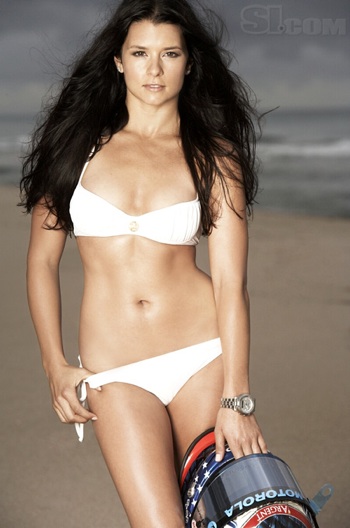
First, if you, the reader were to search for the two driver’s on the internet using Google or some other search engine, you will notice that when you look for Patrick, the first thing that shows up is a picture of her in a bikini or bent over the hood of a car. In fact, before you even hit search in Google, it suggest that you are looking for “Danica Patrick Playboy.” On the other hand, however, if you were you to search for Wallace, the first images, in fact all of the images that come up are pictures of Wallace in her racing gear or pictures of her car. You will not find any pictures of her showing off her body bent over some piece of machinery; I could barely even find any photos where this individual was wearing make-up. I think that for the very reason that Wallace cannot be indulging in “raunch culture” in the reason that I have never heard of her, and I can bet that the reader most likely has never heard of her.
Some people may say that the reason that she isn’t as popular as Patrick is because she is not as good of a driver. At first, Patrick raced in the IndyCar series, which is a different type of vehicle, and she did very well; she got awarded rookie of the year in 2005 and she even won a race which I can only image is very difficult to do when a lot of drivers do not even finish. However, in her debut on Saturday, Patrick wrecked her car about halfway through the race as she got involved in a massive 14-car crash and it ended her day early. Wallace is also a very skilled driver; she had won several junior races and had several other respectable finishes in the NASCAR truck series prior to her appearance in the race Saturday. However, she had about as much luck as Patrick on Saturday, perhaps even less when she wrecked in the first lap and ended her day very early. In the news article, she blames her accident on another driver for making a “dumb mistake on his part.” I believe that from looking from years of experience and simply just performance in that race on Saturday that these two drivers appeared in, Danica Patrick is the better driver.
I believe that much of Danica Patrick’s fame and popularity not only comes from her racing but also from her modeling work. I believe that Ariel Levy would say that yes, Patrick is participating in raunch culture and other feminist writers such as Marilyn Frye would look down upon her for exploiting her body and succumbing to the patriarchy. On the other hand, I very much believe that the same writers and feminist activists that look down upon Patrick would have a lot of respect for Chrissy Wallace because her participation in the sport and her fame are solely due to the fact that she is a skilled driver, she is can be seen as an equal to the men in the sport. As for now, Wallace proves that you do not need to show off your body to be successful and while she may not be as skilled as other drivers, she is just rookie right now and I am sure her skills will develop further after she gets more races under he belt.
Wednesday, February 10, 2010
GO GATE!!!!
After talking about title nine in our class discussion, I thought it was important that you all knew how exactly "Colgate" feels on the subject. This is an article written by our very own athletic director on title nine. Its worth reading. Trust me. Go Gate.
Sunday, February 7, 2010
Females can't be trusted, especially when they're menstruating
 There is always a problem with the system, no matter who you are or where you are from. In America, there are a lot of issues with our notion of a patriarchy, a system formed by men to serve men. The standard or ideal family format in the US is to have the father work a job, nine to five, to support the family while the mother stays at home and takes care of the kids and has dinner ready when dad gets home, of course this doesn't much hold true anymore for as far as I know. My parents both worked a nine to five job, but my dad also worked several other jobs in his time off, while my mom would take care of me and my sister. I guess in a way they do kind of meet the standard. Would this type of family system be considered as taking the path of least resistance, conforming to the way our society says it should?
In Frye's article, she speaks of oppression and how women are oppressed by labels given to men in relation to their sexual activity or how they express their emotions. Will I admit to participating in such labeling? I'm not going to deny it but I do not actively try and label every woman I see, and it is not just men that do these things, I have heard, on countless occasions, a woman calling another woman a slut or whatever. But that could just be some of the things we have talked about with women trying to "get it."
Wednesday, February 3, 2010
Hip-Hip Hooraaaay
Rap music has been a popular from of expression for almost three decades now. This is not to say that hip-hip has been without its controversies throughout the years. Hip-hop has been blamed for the promotion of drugs and alcohol, as well encouragement to degrade women. The latter has perhaps been the larger of the issues through the 80’s 90’s and some of the 2000’s. However nowadays women are willing, if not eager to appear in these rap music videos, consisting of scantily-clad women parading around men, while the rappers deliver lines such as, “B*tches ain’t sh*t but hoes and tricks.” This would not seem very empowering, but from Ariel Levy’s point of view in, Female Chauvinist Pigs, this is an all too familiar form of feminism, apparent in this ‘third wave’. The form of media that I chose to analyze is the now infamous “Tip Drill” song and music video from Grammy winning artist Nelly. This song, as well as the video, has been publicly ridiculed for it’s demeaning lyrics, and images of naked women, and men defiling them. But why do these women choose to participate in this? In what is perhaps the epitome of “raunch culture”?
One of Levy’s main arguments is that, "all empowered women must be overtly and publicly sexual.” But does this mean that women who participate in the raunchiest of acts such as flashing a Girls Gone Wild crew, or appearing in a rap video have reached some type of empowerment? I think Levy would agree with me, in saying that the women who populate this video are doing nothing more than allowing men to display their dominance. Looking through the lens of Levy, I am appalled, and feel as if this form of media actually succeeds in bringing women as low as one would think was humanly possible. However, as a man, upon my first time seeing this music video I was not appalled or ashamed, but awed and completely untouched by the degradation of these women. To this day, the video does not strike me in any way as any form of empowerment to these women. I suppose one could argue that because most of the sexually explicit scenes involve one or more women, perhaps this is what Levy meant when some women proclaimed that being empowered meant working with men, and feeling entitled the, “cigar afterwards, and the strip club even later.” Indeed many other female rappers such as Trina and Lil’ Kim feature multiple women in their music videos as opposed to men. According to Levy, the women who feel powerful want to emulate the fantasies of men, even if this includes demeaning other women, as well as themselves in the process, in the fight to fit in and feel equal.
It is no secret in the hip-hop industry that women who appeared in music videos could use the exposure as a means of securing other jobs such as modeling, and even some attempting to be actors and musicians themselves. So are these women in fact seizing their womanhood, or are they only helping to further the gap? I would argue for the second option. I believe quite strongly, as I’m sure Levy would agree, that many of these women have very few alternatives, leading to hundreds of women willing to do close to anything for a few dollars. The fact that this is not only deemed acceptable by such a large number of women, as well as the industry as a whole, could be considered the definition of raunch culture in our society today. But there are no doubt women behind the scenes as members of the crew, or even employees of the distributing company over the shoot. So is it fair to judge those in front of the camera for only attempting to make it where those behind the scenes are in terms of success? For sure, I am not the one to answer that question. But I believe Levy would surmise that those behind the scenes are no less guilty of the chauvinistic tendencies that men are constantly blamed for.
As a whole, I think Levy would be disgusted but not surprised. This only gives credit to her views on raunch culture today, and what is acceptable, as well as the large degree as to which this new cultural shift only serves to alienate women even further.
The Exception

Levy seems to constantly criticize every aspect of this notion of “raunch culture.” She creates this never-ending list of things women should not do. Her claim that women are making themselves inferior by exploiting their own sexuality, along with the sexuality of other women is a brave statement by a woman who fails to provide any type of solution. Her constant “women can’t do this” attitude is hard for me to take seriously. The women she uses for examples range from Heff’s playboy bunnies to very successful corporate women. After reading a decent portion of Levy’s book, I can honestly say that I don’t know one woman of that Levy would approve. For instance, here is a picture of Ariel Levy: woman who claims to know all about femininity. I am almost positive she is wearing make-up, she clearly has her hair done and is wearing what my mother would say, is a skimpy shirt. She seems to be eating her own words, doesn’t she? Levy, after explaining what raunch culture is, seems to show concern with people justifying this raunch culture as a feminist right.
So for my blog post, I decided to attempt to challenge Levy in all her glory. My video is of a tradition Tahitian dancer doing a traditional Tahitian dance. She is performing in the most important event in Tahiti, the Heiva, which has been around for 122 years. I grew up with Tahitian dancing embedded in my culture, along with the traditional Hawaiian Hula dancing. In fact, the first Hawaiians came from other parts of Polynesia, so it can be assumed that the Hula was born from the ancient Tahitian dance. Legend has it, that this type of dancing has been around since the ancient times of Polynesian culture. So with that being said, it will be my job to try and claim that Levy’s entire concept of “raunch culture” can be challenged with a trip back to ancient cultures. I am trying to prove that there are exceptions.
Because we already know Ariel Levy does not approve of “raunch culture”, I would first like to examine some of Levy’s claimed causes for why women participate in the diseased “raunch culture.” She feels women don’t want to be excluded. She sees it as a cry for attention and a need for a sense of false self-confidence. She also views it as a reason to make money and feels that if women do refuse to be a part of “raunch culture” they will be seen as a prude. Now, this Tahitian dancer: is she a part of raunch culture? According to Levy’s definition: absolutely. Were her ancestors a part of raunch culture? She is wearing a tiny top along with a tiny skirt, so basically she is wearing next to nothing. If this were on a girl walking down the streets of NYC, Levy would be the first one to judge her as a “female chauvinist pig.” But can anyone really claim this particular female to be one? She is participating in a tradition dance that has been around for centuries. So would it be fair to say that this is an example of feminism in this wave of raunch culture? Absolutely not, yet she seems to be wearing about the same amount as those girls in Playboy.
Speaking of those girls in Playboy, Ariel Levy believes that all they want is attention and flaunting their bodies give them a sense of self-confidence. Watch this dancer move. Watch her around 0:30 seconds. She faces her ass to the front of the audience, goes down and comes right back up. Sound familiar? I seem to remember a group of girls doing this, I think they were called strippers. Around 1:08 the Tahitian dancer is basically lifting up her skirt. Again, does that make her a “female chauvinist pig?” Sex is a part of Polynesian culture. I definitely think this has something to do with female sexuality, however I don't think it is a problem, and I’m pretty sure everyone at the Heiva festival in Tahiti will agree. So is every girl who shows a little skin, shakes her ass and lifts up her skirt a “female chauvinist pig?” Ariel Levy would say so, yet I’d beg to differ. Word of advice: don’t be too quick to judge.
In her book, she claims that women participate in this “raunch culture” to become successful and make money. But traditional Polynesian dance was never about attention, success or money. It was embedded in the culture. It was something that every girl (at some point in their lives) participated in. I’ve actually danced Tahitian one summer, and the hula another. It is simply part of the tradition. Now, here is a traditional Hawaiian dance. The cast is a little different. (the youtube embedding was disabled, so here is the link) Look around 1:40. Those men, grown men, are shaking their asses just like the girl in the Tahitian video. It’s not about attention, or money. It’s not about showing off your body to elude self-confidence. How can Levy say that every girl (or guy in this case) who shakes her but with skimpy clothes is desperate for attention? It just isn’t true. Maybe there is more to it.
As previously stated, Levy claims that women who refuse to participate in “raunch culture” feel that if they do so, they will be excluded or seen as a prude. In this case, it is completely false. I choose not to participate in traditional dance, although many of my friends and family continue to dance today. In no way was I ever seen as inferior for not choosing to wear tiny clothes and dance in front of big audiences.
Maybe Levy is just looking at Western Culture, or maybe Levy is just set in her ways. It was my job to try and play devil’s advocate. Compare my Tahitian dancer to Shakira in Andrew’s post. Both shake their hips, in fact, I’m pretty sure my dancer has less clothes on. Isn’t it true that Shakira is from Colombia? Maybe dancing like that is a part of Colombian culture. Maybe it has been around long before the Britney Spears and Beyonce music videos. It is awfully bold to say that every girl who participates in what Levy calls “raunch culture” is negatively affecting the progress of feminism. Maybe this claim that the rise of raunch is making women move backwards in their trek towards what they have been fighting for, for over a hundred years. But it isn’t fair to say that every girl who wears “slutty” clothes and shakes her ass is participating in this “raunch culture.” Maybe it's a different kind of culture. We live in a diverse nation, and people come from all kinds of cultures and traditions. This close-minded explanation of a “female chauvinist pig” fails to look beyond the porn star. The definition fails to include all types of females, although Levy claims that it does. Maybe some women do it for other reasons. So here it is. Here is the exception.
Monday, February 1, 2010
Her hips don't lie
When I think of feminist or feminism, images of strip clubs and pornographic videos do not come to mind, but according to Ariel Levy, these are forms of third wave feminism. In her book, Female Chauvinist Pigs: Women and the Rise of Raunch Culture, Levy analyzes women and feminists roles in today’s culture, though to me they seem as if they are the exact opposite of the things that feminists have been fighting for for three generations. In today’s pop-culture, it seems that a female musician cannot produce a music video or put on a performance without wear skimpy or raunchy clothes, more specifically, I’m talking about Shakira Isabel Mebarak Ripoll or simply Shakira. Shakira is world famous and is known for a number of hit songs and he belly dancing, but in this article I want to look at Shakira’s more recent hit, “She wolf.”
In the song, Shakira sings about being the aggressor in a relationship or just a hook up where usually the man is the aggressor with some stereotypical pickup line. She goes on to express that she is staring at a man across the bar, really eyeing him up or as she says it, “Sitting across the bar, staring right at her prey it’s going well so far she’s gonna get her way.” These two lines of the song, to me, seem to be a very aggressive move, especially for a woman because if a man was staring so intent at a woman in this fashion it would come off as kind of creepy and rude. However, a feminist that is fighting for equality would just that if men can do it, then why can’t women, what is so different if a woman acts in this way? I can just think of a few responses from a couple different perspectives: the girl’s friend, “Eww, why are you looking at him like that?” or the man’s friend, “Man, that girl must really want the dick.” Why would this situation call for two such negative responses towards the advancing female? Yet a man making the same advances would most likely be met with positive responses from the same two individuals as listed above, something from the girl’s friend like, “Oh my god, that guy is totally checking you out” and the man’s friend would say something along the lines of “Get it.” Clearly in this example taken from the song, the female advance is a little more unusual and, I guess to me, would be a little surprising to see a woman act in this way. I’m and not sure why I see it this way, is it because I am just conforming to mainstream society and falling into the same mold as everyone else?
In the music video, Shakira is wearing some very form fitting and revealing attire, one outfit has a bikini cut bottom and another has sections missing form the midsection and a leg is missing. I don’t believe that I would ever see a woman walking around Colgate to go to class in this attire (in warmer weather of course) or even going out in the evenings with this type of style. What makes an artist want to prance around in this type of clothing for everyone to see? One possible reason is that she wants to show off her toned and fit body, that I am sure she has to work very hard for. Does she feel empowered as Levy talks about in her book or does she feel that she has to dress like this to entertain an audience. I think this song is targeted for young women, probably from teenagers to twenty year-olds if not older, but I would have to say that the music video is more appealing to young men or just men of all ages because I know myself that I would watch this video more than once but on the other, had I been looking at some rap video where men have their shirts off I probably wouldn’t be too into watching that. Do women feel the opposite, they want to watch men with their shirts off and shy away from women with skimpy clothing?
The next thing I would like to examine is Sharkira’s moves she does and a certain sound that she makes that reoccurs in several parts of the song. Now I understand that some of her dance moves come from a belly dancing background, however, in some parts of the video, especially in the parts that she is in a large cage, can hardly be called dance moves. When she is in the cage, Shakira is moving her body and putting herself in very sexual positions, maybe to signify her caged up sexual desires, but she is spreading her legs and contorting her body into what I can only image can be uncomfortable for her. Again with this part of the video, who or what is she appealing to, is she trying to appeal to men or simply just expressing her feelings? Another element of sex that can be heard in the video is when Shakira makes these panting sounds, I’m not sure if she is trying to pant like a wolf or if it could be related to some sexual theme.
I’ve come to the conclusion that the whole video is about her going out and having fun and maybe finding a man, but in the end she goes to bed with her apparent husband or boyfriend. I guess this could be similar to “the problem that has no name,” women wanting more than a life as a housewife, but it is set in modern times. What I am trying to get at is, is Shakira trying to express feelings or a desire to occasionally want to have an extramarital relationship that can be seen happening in recent events with Tiger Woods, some kind of promiscuity?
After all of this analysis of this song and the music video, I can’t help but realize that I am missing and cannot speak much on a woman’s perspective and how a woman would react. Maybe you all can help me to understand more about this song and enlighten me as to why an artist would perform this way because I have posed several questions that I do not know the answers to.
One more thing, here is the link to the website where I found the lyrics.
Subscribe to:
Posts (Atom)


